Episode overview
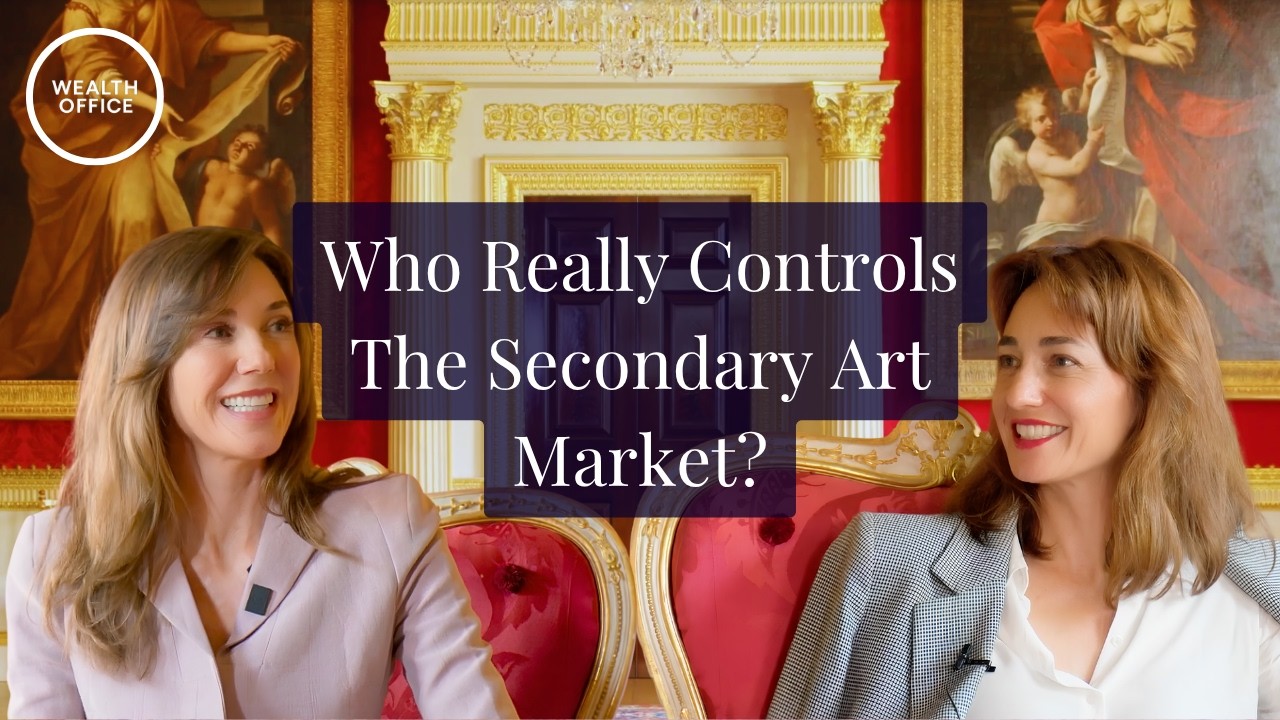
In this edition of Wealth Office X, Michael Macfarlane brings together Catherine Freeman and Bigna Pfenninger, introduced as two of the world's leading authorities on the secondary art market. The subject is the market for works that have already had at least one owner. Pfenninger notes that this includes living artists, who can and should develop a secondary market long before their work is historic. Freeman describes many systems within one market, with ultra-contemporary, Impressionist and Old Master works each behaving differently.
Much of the conversation concerns how value is made. Freeman argues that collectors are central to legitimacy, because the works they choose, place in museums and assemble into recognised collections carry more weight when they come to sale. Pfenninger describes patronage as a matter of proximity and ecosystem, citing Singapore as a market with the transactional machinery in place and an ecosystem still being built. Both describe the top of the market as thin and private. Pfenninger puts the number of the largest trophy works at around 2,500, and describes her work as global matchmaking conducted quietly, often through freeports and holding structures.
The final section turns to finance and the future. Macfarlane cites a Deloitte and ArtTactic projection that art-secured lending could reach US$42 billion to US$50 billion by 2027. Freeman links that growth to the availability of price data, which gives banks a reference point. Pfenninger, who says she tokenised a Picasso in Switzerland in 2021, expects tokenisation to become ordinary infrastructure for fractional ownership. Freeman expects a multipolar market shaped by younger collectors who want transparency, experience and better tools for provenance.
Key ideas
The secondary market includes living artists
Pfenninger defines the secondary market as every work not sold straight from the studio, or via a dealer, to its first owner, whether it is resold after centuries or after two years. She rejects the common assumption that an artist must be dead for a secondary market to exist. In her view a living artist may very well have one already, and should be trying to develop it.
Collectors confer legitimacy
Macfarlane suggests that the primary market creates visibility while the secondary market confers legitimacy. Freeman agrees that collectors are central. A work chosen with intent, placed in a museum or held in a recognised collection, carries more cachet at auction than one chosen at random. In her account, the story a collector builds around a collection becomes part of the value of each work within it.
Patronage depends on an ecosystem
Pfenninger argues that patronage works best close to home, where a collector can meet artists, dealers and institutions. Financial capacity alone does not create a market. She cites Singapore as a city with all the transactional modalities in place that is still building the appetite and habit of studio visits a secondary market needs. Freeman adds that younger patrons may support artists jointly and use social media to widen their circle.
Blue chip as ballast
Freeman describes blue-chip works as established enough that their value range is no longer debatable, with prices from around 500,000 up to a recent sale of 180 million. Holding a few such pieces, she says, gives a collection steadiness, like gold bars in a safe, and frees the collector to be more playful with contemporary or lesser-known artists. Pfenninger judges the best collections as those where the sum is larger than the parts.
The top of the market is quiet
For the most valuable works, Pfenninger describes a closed and discreet process. Works often sit in freeports and may change hands without moving, sometimes through the sale of a company that holds a single work. Auction carries exposure, so much of her work is private, global matchmaking among very few buyers. She calls it a scarcity market of about 2,500 trophy works, run on networks of trusted colleagues.
Data made art bankable
Pfenninger sees the art market industrialising before it financialised, with fairs, a global gallery system and transparent price data coming first. Freeman argues that once banks have reliable historical values, art can be borrowed against like a house or a boat. Pfenninger adds that for most clients art remains a comfortable store of value. Owners tend to borrow against it because they are reluctant to sell when they need liquidity elsewhere.
Tokenisation as plumbing
Pfenninger notes that fractional ownership is old, as five brothers who inherit a work already know. She sees tokenisation as a cheaper, more effective way to divide ownership and expects it to become unremarkable infrastructure. She is less sure about stock-exchange listings, which may bring trading volume without depth. She sees clearer value for museums, donorship and joint ownership, where many people share a stake in a work.
In their words
It's not only a social investment when you're investing in art, it's more of a civilizational investment.
— Catherine Freeman, Wealth Office
It's not so many stakeholders in the entire market. For the largest trophy works, there are 2,500 works in the world. That is a scarcity market.
— Bigna Pfenninger, Wealth Office
And having a few of those bedrock investment pieces, blue chip within that collection gives you the steadiness to be able to be more playful because those pieces have trackable, you know, marketability over time.
— Catherine Freeman, Wealth Office
I believe fractional ownership is nothing new. That has always happened. … My idea is that tokenization is basically the cheaper and more effective construct to parcel up into fractional ownership. It will soon not be so exciting.
— Bigna Pfenninger, Wealth Office
I foresee that the future of the secondary market is very multipolar. It's not going to be just the east is collecting and the west is selling.
— Catherine Freeman, Wealth Office
Quotes are taken word for word from the episode transcript.
Questions this conversation answers
What is the secondary art market?
In Bigna Pfenninger's definition, it covers every work that has already had an owner, as distinct from works sold directly from the artist's studio or through a dealer to a first buyer. It applies whether the previous sale was centuries ago or two years ago. She stresses that living artists can have a secondary market too, and should be trying to develop one.
Why has lending against art grown so quickly?
Catherine Freeman links it to data. Auction records and market reports now give a historical trajectory of values, so banks have a reference point and can treat art like a house or a boat. Bigna Pfenninger adds that most clients see art as a comfortable, movable, low-cost store of value, and borrow against it because they are reluctant to sell.
Do the guests think tokenisation of art will last?
Bigna Pfenninger expects tokenisation to become part of the market's infrastructure, describing it as a cheaper and more effective way to create fractional ownership, which has always existed. She doubts that listing art on a stock exchange would bring depth as well as trading volume. She sees particular promise for museum holdings, donorship and joint ownership.


 Editorial · Never sponsored