Episode overview
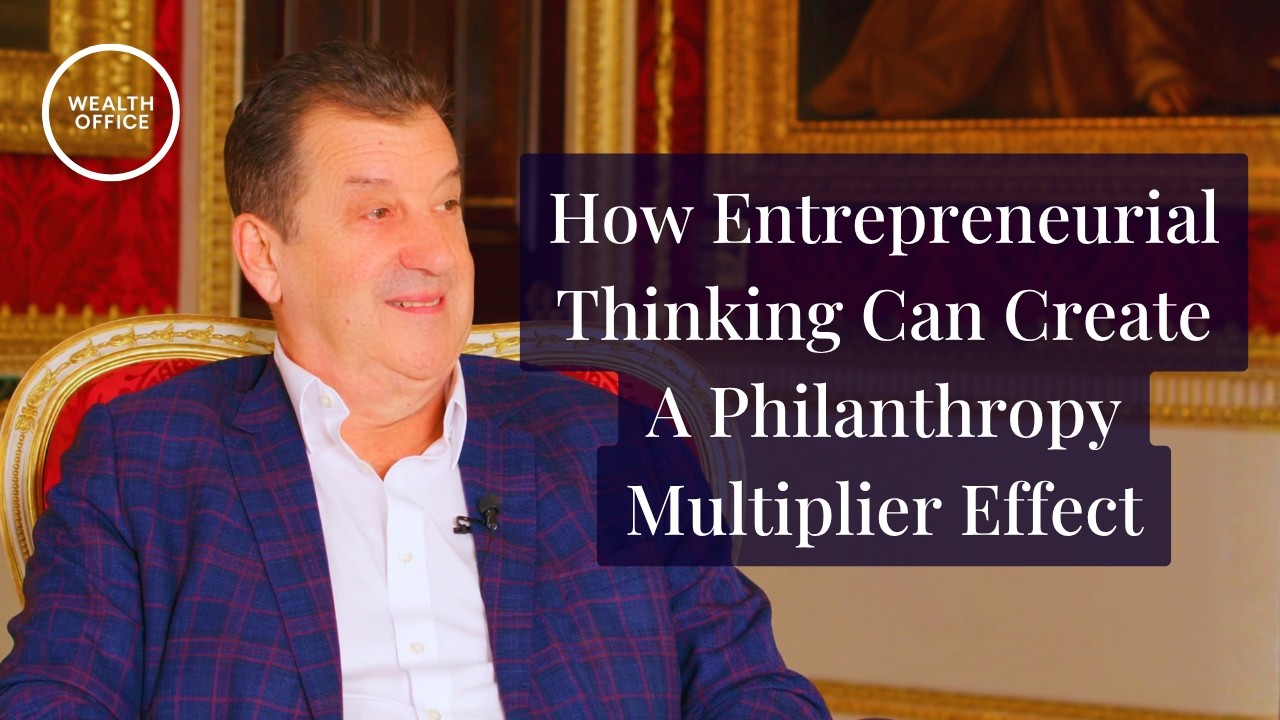
Michael Macfarlane introduces Howard Bilton as an entrepreneur who built a global business at the centre of international capital and then designed a different approach to social impact. Through the Sovereign Art Foundation, Bilton has created an ecosystem connecting artists, collectors and institutions that converts cultural activity into funding for art therapy programmes for vulnerable children. Macfarlane asks whether entrepreneurs are now designing systems for impact instead of simply donating wealth once it has been made.
Bilton says that is exactly his intention. He set out to leverage the sum he could afford to give by building an operation that generates more than it spends, and he says it achieves double. The foundation runs three professional art prizes for established artists who are well known at home but not internationally. Artists receive half of any sale and the foundation takes the gallery's portion. The Sovereign Group contributes people and expertise across 13 countries, and schools prizes raise awareness. Bilton describes a project in Cambodia supported for 20 years, where many children have returned as teachers, and a three-year Hong Kong University study that found the therapy's effect to be dramatic.
The conversation then widens. Bilton, who moved to Hong Kong in 1992, describes China's shift from cheap manufacturing to innovation, the long-term planning its political system allows and the speed of decision-making across the region. He reflects on growing Sovereign slowly and steadily to 600 people, on AI as a source of efficiency that still needs practical expertise, and on his Portuguese vineyard, now run with his son Tom, which pledges 20% of profit to the foundation. As a collector he calls the art market soft and warns that most art has no resale value. His advice to young founders is persistence and hard work, with social impact usually following success.
Key ideas
Leverage the giving budget
Howard Bilton set out to use the sum he could afford to give as working capital for an operation that would generate more than that sum. In his view the approach only makes sense if it produces more than it costs; otherwise it is simpler to write cheques and let others build the infrastructure. He says the foundation aims to double the money and achieves it, before counting wider benefits.
An ecosystem with aligned incentives
The Sovereign Art Foundation runs three professional prizes for established artists who are famous in their own countries but not yet internationally. They gain an international platform and new buyers, and still receive 50% of any sale, while the foundation takes the gallery's half. Bilton persuades reluctant galleries that losing one sale is outweighed by the status and later sales a finalist's profile can bring.
Invest in art instead of only donating
Bilton's offer to supporters is unusual. Instead of asking for donations, he offers the opportunity to buy art, so that the buyer gains a work that gives pleasure for life while the gallery portion helps disadvantaged children. The ideal, he says, is to buy a piece and donate on top. Events also bring volunteers and raise awareness of the problems the foundation addresses.
Art therapy is serious work
Bilton describes the first project the foundation supported, in Cambodia, helping children who had suffered abuse and who would draw or paint their experiences when they would not describe them. Twenty years on, many have rebuilt their lives and some have returned as teachers. A three-year study by Hong Kong University, commissioned for a funding application, recorded what Bilton calls dramatic improvement.
Slow and steady compounding
Bilton started Sovereign in Gibraltar in 1987 with one assistant and grew it to 600 people without borrowing, hiring only when the money was there. He attributes its success to a slow and steady grind, good standards and roughly 10% growth a year. That predictable core business has in turn allowed him to pursue the art foundation and winemaking.
Asia's speed and long horizon
Having moved to Hong Kong in 1992, Bilton argues that China has reinvented itself from low-cost manufacturing into a more innovative, higher-end economy, backed by heavy long-term investment. He sees its political continuity as an advantage for business planning, while adding that the West would not adopt that system because life is about more than business. He also admires the region's work ethic and speed of decision.
A second family business
Bilton had no ambition to bring his children into Sovereign, wary of promotion by relationship. His son Tom instead pitched to run the family's Portuguese vineyard, which Bilton calls a trophy asset and rarely lucrative. He sees farming as a natural family business and a good way to pass on wealth by making the recipient work for it. The winery pledges 20% of profit to the foundation and carries children's art on its labels.
In their words
So rather than donating a fixed sum, I wanted to use the sum that I had in mind and could afford to create a business which would generate more than that sum.
— Howard Bilton, Wealth Office
And it only makes sense to do it the way I'm doing it if you're generating more than you're spending.
— Howard Bilton, Wealth Office
It's very serious and the effect of it is dramatic, it's transformational.
— Howard Bilton, Wealth Office
It is a trophy asset, and with very few exceptions, it's not going to be an investment at all. It's going to be an investment in your happiness and your general joie de vivre, because it is a lovely business to be in, but it is not lucrative.
— Howard Bilton, Wealth Office
So it's really, I mean, it might be an old fashioned view, but it's my view for sure that there is no substitute for hard work and perseverance and that's what builds a business.
— Howard Bilton, Wealth Office
Quotes are taken word for word from the episode transcript.
Questions this conversation answers
What is the philanthropy multiplier effect Howard Bilton describes?
Bilton uses the money he could afford to donate to run an operation that generates more than it spends. The Sovereign Group supplies people and expertise, art prizes generate sales, and the foundation keeps the gallery's share of each sale to fund art therapy for disadvantaged children. He says the model doubles the money, before wider benefits such as awareness and volunteering.
What evidence does Bilton give that art therapy works?
He cites a project in Cambodia supported for 20 years, where children who had suffered abuse could draw or paint what they would not describe. Many have rebuilt their lives and some have returned as teachers. He also cites a three-year Hong Kong University study, produced for a funding application, which measured what he calls dramatic improvement in the children.
Should young entrepreneurs build social impact into a business from the start?
Bilton thinks it would be nice but is realistic about it. In his view most founders need all their energy to reach the point where they can think about philanthropy. He notes that a business can pledge a share of profit to charity from the outset, as his winery does, but stresses that hard work and perseverance come first.


 Editorial · Never sponsored