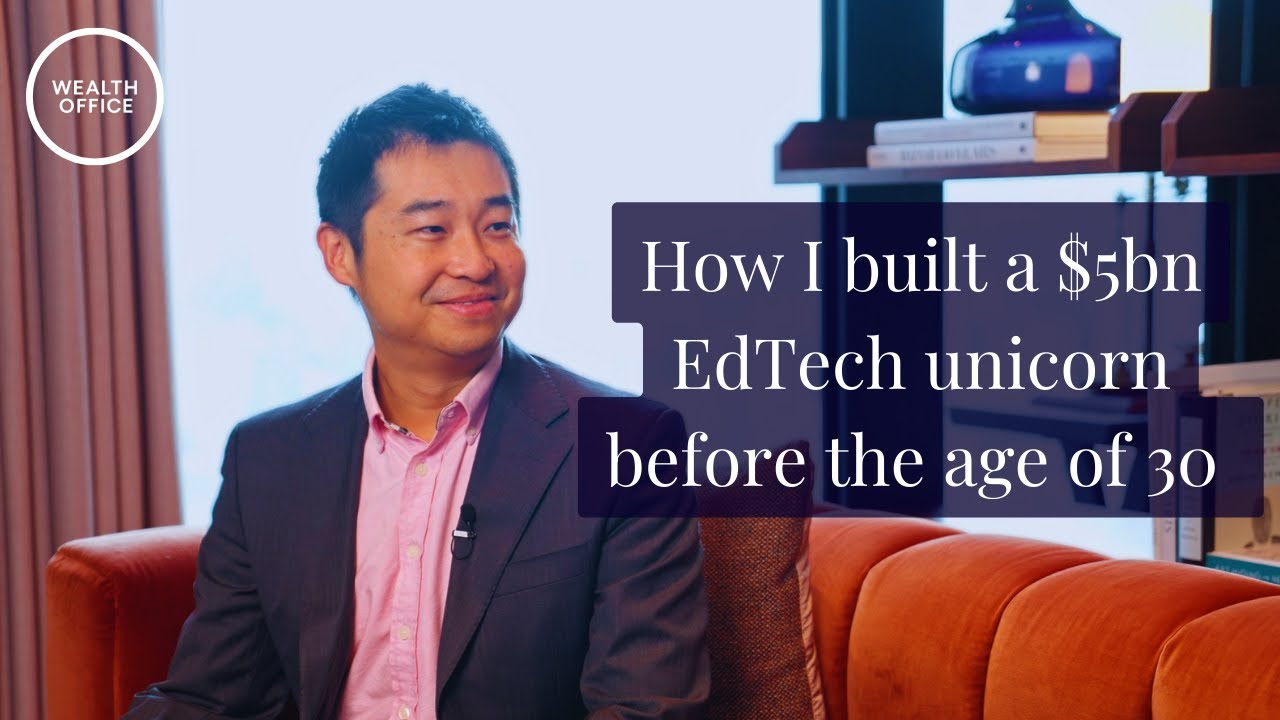
Episode overview
Shield Xiao Dun's path into education began with a stranger's generosity. himself a Wealth Office guest, paid for Xiao Dun's schooling at Millfield in the UK and most of his Cambridge tuition, and never asked for anything back. Years later, at a gathering of around 30 scholars he had sponsored, Louey recommended the film Pay It Forward. In conversation with Michael Macfarlane, Xiao Dun describes education as the most meaningful way he could repay that opportunity, and technology as the way to extend it to as many people as possible.
The episode traces his first company, 17 EdTech, which he started in 2011 and listed on Nasdaq in 2020. It grew to 20,000 staff by meeting China's vast demand for better schooling, which far outstripped the supply of good teachers outside first-tier cities. Xiao Dun explains how mobile phones and faster networks made learning possible almost anywhere, and how the 2021 double reduction policy forced a painful pivot. He now runs a Delaware-incorporated company in Palo Alto building AI tutors that adapt to each learner, at a fraction of the cost of the best human teachers. He expects assessment to move towards mastery and real-world output.
The conversation widens to China's technological strength, why the most successful Chinese tech companies have listed in the United States, and the value of clear, stable policy. Xiao Dun also sets out two dystopian scenarios he fears AI could produce. In one, people are kept consuming without growing. In the other, a tiny group controls the compute and makes every strategic decision. His preferred society is shaped like a cactus, with many branches and many peaks. Throughout, he returns to the same principle. Purpose stays fixed, and the company is the vehicle for it.
Key ideas
Paying it forward as a life plan
Xiao Dun traces his career to who funded his education at Millfield and Cambridge and asked for nothing in return. He says that had he used the money to build a house in Hong Kong, it would not have been as meaningful as what Louey actually gave him, which was an opportunity. Any enterprise that creates value for society pays it forward, in his view, and education through technology is his chosen route.
Demand everywhere, supply in a few cities
17 EdTech grew, Xiao Dun explains, because Chinese families everywhere regard education as the path to a better future, while good teachers and schools are concentrated in cities such as Beijing, Shanghai and Hong Kong. A family in Tibet or Yunnan could not buy what did not exist locally. Mobile phones and successive network generations made it possible to reach those learners, and solving that gap is how the company captured value.
From 20,000 staff to AI tutors
His new venture builds AI tutors that guide each learner in a personalised way. Because generative AI began with language models, a tutor can answer even a bizarre question patiently, at any hour, and follow a student's curiosity as far as they want. He likens learning to a tree, with shared roots in literacy and numeracy and every leaf different. Macfarlane notes that AI now does what 20,000 people once did.
Assessment will move to output and mastery
Asked how self-taught learners could gain recognition, Xiao Dun expects the answer to come from outside existing institutions, which face the innovator's dilemma. Interviews, in his experience, are unreliable, and judging someone's output over time is far better. That was too labour-intensive for schools before AI. Now that AI can judge essays and understand video reasonably well, he foresees a mastery-based system built around realistic challenges.
Two dystopias and a cactus
Xiao Dun takes AI risk seriously. His worst case is a population kept consuming, with something like dopamine, while never growing. His second is one person, or a thousand, owning the compute and the best models and making every decision. He prefers a society shaped like a cactus, with many branches and peaks, where hard work is rewarded and value is measured in more than money.
Policy certainty matters to founders
The 2021 double reduction policy hit 17 EdTech hard. Xiao Dun says he understands many of the government's reasons but still disagrees with how abruptly it was executed. He argues that clear long-term boundaries, such as stating that compulsory education cannot be privatised until 2049, would let entrepreneurs plan. He senses a more stable policy period has begun, and he incorporated his new company in Delaware.
Impact built into the business
Xiao Dun and fellow scholars fund a Pay It Forward scholarship, but he accepts it stops when funding stops. He hopes his company, charging users just enough to sustain itself, will have the larger impact. He admires technology that the wealthiest and poorest use alike, and says many entrepreneurs of his generation now approach impact this way.
In their words
For me, a happy life is a meaningful life.
— Shield Xiao Dun, Wealth Office
I think the most important goal for education in this era is for someone to be motivated.
— Shield Xiao Dun, Wealth Office
I think the traditional culture of China is a culture that enables people to work well. But there was a bug of not valuing science and technology enough. We have been trying to put patches on this.
— Shield Xiao Dun, Wealth Office
So the best tech products are made so that the wealthiest people and the poorest people use the same products.
— Shield Xiao Dun, Wealth Office
Everyone's different, so they need different education, but the access should be the same. Everyone should be able to get the best access whenever they want.
— Shield Xiao Dun, Wealth Office
Quotes are taken word for word from the episode transcript.
Questions this conversation answers
Who is Shield Xiao Dun?
Shield Xiao Dun grew up in a modest middle-class family in Beijing and won scholarships to Cambridge, MIT and Harvard. In his twenties he founded 17 EdTech, which reached 20,000 employees, listed on Nasdaq and peaked at a $5 billion valuation. He now lives in California, where he is building AI tutors intended to make high-quality education widely accessible.
What does 'pay it forward' mean in Shield Xiao Dun's story?
Louey paid for his schooling in the UK and much of his Cambridge tuition without asking for anything back. Louey later recommended the film Pay It Forward to the scholars he had sponsored. Xiao Dun took it as a guide, and describes giving others an educational opportunity, at scale through technology, as his way of repaying that help.
How does he think AI will change education?
He expects AI tutors to give every learner patient, personalised guidance at any hour, at a fraction of the cost of top human tutors. He believes this makes lifelong learning practical, shifts the main challenge to motivation, and will push assessment towards mastery and real-world output. He also warns that the same technology could produce dystopian outcomes if misused.


 Editorial · Never sponsored